What This System Powers
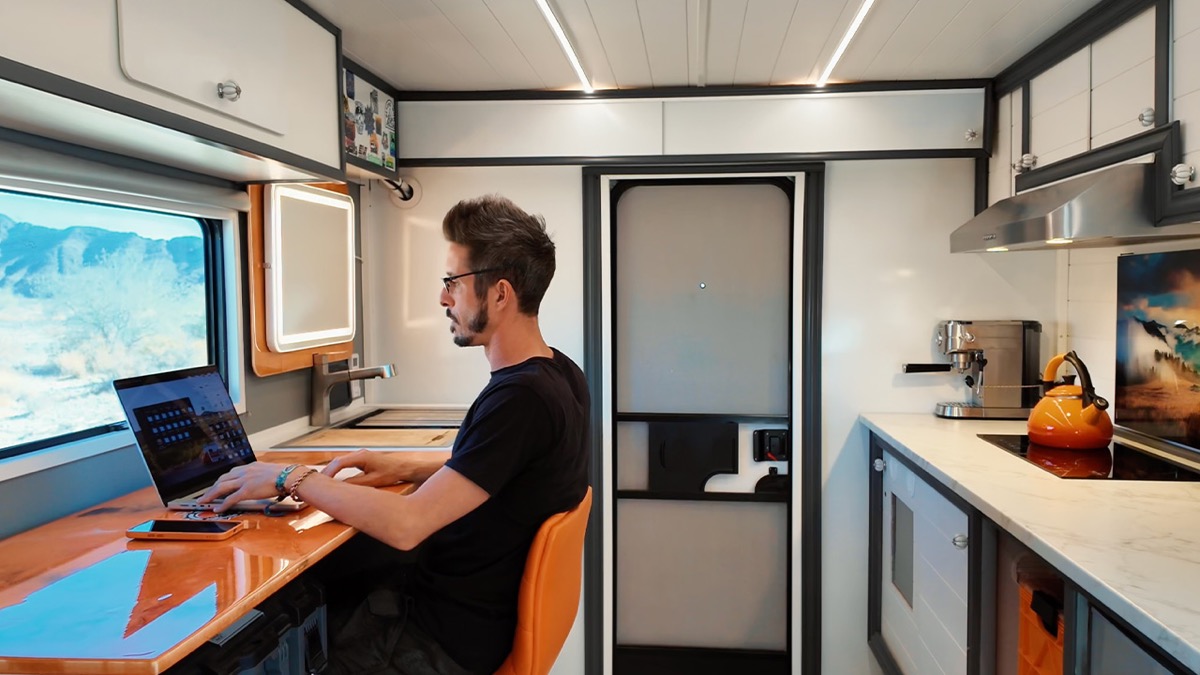
Before we get into the hardware, it helps to understand what I'm actually running on solar every day. My box truck is a fully functional home — I run a residential-style fridge, a Ninja blender, a laptop and monitors, LED lighting throughout, fans, phone and battery charging, and an air conditioner during the hot months. Everything is powered by the sun. No generator. No shore power hookup except as a backup option.
Most people assume off-grid solar means constant rationing and compromise. That hasn't been my experience. With a properly sized system, you can live comfortably without thinking about power at all.
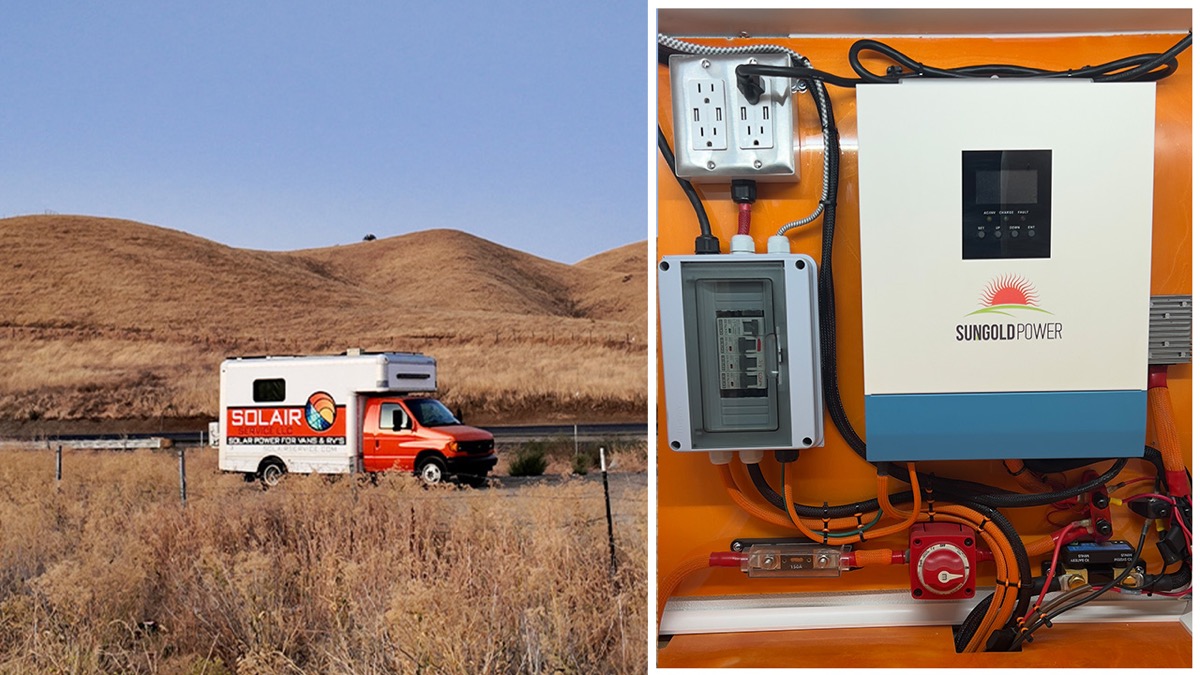
The Three Main Components
1. Solar Panels
The panels live on the roof and determine how much energy you can collect throughout the day. Your limiting factor is roof space — it dictates how many watts you can physically install. My roof is 14 ft long by about 7.5 ft wide. I installed four 320W Axium panels for a total of 1,280 watts of solar capacity.
Those wattage ratings are produced under laboratory conditions — real-world output will be somewhat lower. I purchased these panels brand new directly from a solar distributor for $97 each. I have a separate video explaining how to find deals like this (link in the description).
In most scenarios, fill the roof with as much solar as you can afford. Extra solar capacity costs relatively little and gives you headroom for cloudy days, high-consumption periods, and future appliance additions. You'll never regret having too much solar.
2. Hybrid Inverter / Charger
This is the heart of the system. A hybrid inverter/charger is a single device that does three things: converts solar DC power into 120V AC for residential appliances, charges the battery bank, and accepts shore power input as a backup. Buying one unit that does all three is significantly cheaper than purchasing a separate charge controller, inverter, and shore power charger.
I chose the Sun Power 3000W 24V unit, currently available on Amazon for $539. It handles everything cleanly and I've had zero issues with it over years of daily use.
3. Lithium Battery Bank
The battery bank stores energy collected during the day so you can run appliances at night or on cloudy days. I installed two 12.8V 200Ah LiFePO4 batteries wired together for a combined storage capacity of 5,120 watt-hours. Lithium iron phosphate batteries are worth the premium — they're lighter, last significantly longer, and can be safely discharged to around 10% capacity without damage.
These batteries are currently selling on Amazon for $499 each.
Full System Cost
| Component | Spec | Cost |
|---|---|---|
| Solar Panels (×4) | 320W Axium, purchased from solar distributor | $388 |
| Hybrid Inverter/Charger | Sun Power 3000W 24V | $539 |
| Lithium Batteries (×2) | 12.8V 200Ah LiFePO4 | $998 |
| Total | $1,925 |
That's the core system. Wiring, fusing, breakers, and the electrical cabinet add to the total, but the three components above are the major line items. All products are linked in my Amazon shop (description below the video).
How to Size Your Own System
This is the part most people skip — and then wonder why they run out of power. Take 20 minutes to do this math before you buy anything.
-
01
List every appliance and its wattage. Most appliances have a wattage label on the back or bottom. A Ninja blender runs at 1,000W. A residential fridge might average 150W. A laptop around 65W. Write them all down. Then estimate how many hours per day you actually use each one.
-
02
Calculate daily watt-hours. Multiply each appliance's wattage by its daily hours of use. The blender runs 5 minutes to make a smoothie = about 92Wh. Add everything up. That's your estimated daily consumption. My number comes out to roughly 5,575Wh per day — assuming I'm running the AC, which only happens a couple months a year.
-
03
Size your solar to match or exceed that number. Panels don't produce their rated output all day — assume about 90% of rated capacity under good conditions, and plan for roughly 5 peak sun hours per day on average. That's the amount of time the sun is strong enough to drive meaningful production.
-
04
Size your battery bank generously. Batteries cover nights and cloudy stretches. I recommend a bank that holds up to twice your daily usage. Running out of power is never fun, and extra battery storage is cheap insurance.
The Math on My System
Solar production: 4 panels × 320W × 90% efficiency = 1,152W peak output
Daily harvest: 1,152W × 5 peak sun hours = 5,760Wh per day
Battery storage: 2 × 200Ah × 12.8V = 5,120Wh total
Usable storage: 5,120Wh × 90% (lithium discharge limit) = 4,608Wh available
My solar harvest closely matches my daily usage on a high-consumption day, and my battery bank covers nearly a full day of usage without any sun. In practice — since I rarely run the AC — I almost always have a full battery bank and surplus solar throughout the day.
Solar panel wattage ratings are measured under ideal lab conditions. Real-world output varies with panel angle, temperature, shading, and seasonal sun hours. Build in a buffer. When in doubt, add another panel — the marginal cost is low and the headroom is worth it.
The Bottom Line
For under $2,000 in components, you can build a solar system that powers a full residential lifestyle indefinitely — no utility bill, no hookups, no generator noise. I've been running this setup for years without a single day of power anxiety. The sun is free. Collect as much of it as you can.
All the products I mentioned are linked in my Amazon shop. I only list gear I actually use and stand behind. See the video description for direct links.
Watch the Full Video
The complete walkthrough — every component, every wire, every cost. See the full system in action.
Ready to Find Your Rig?
Browse Brad's personally curated listings of built-out vans, box trucks, and skoolies ready for life on the road.
Browse Rigs for Sale → Find a Builder